
SDA Design Categories Explained
The quick version
- SDA funds the physical home, not the support workers inside it
- The four SDA design categories: Improved Liveability, Fully Accessible, Robust, and High Physical Support
- Each category is built for a different type of disability and support need
- Only around 2.4% of NDIS participants currently have SDA funding
- An OT assessment is the single most important piece of evidence for approval
- St Jude’s supports people exploring SDA across WA and QLD. Call us on (08) 9279 4343 (WA) or (07) 2800 6050 (QLD).
If you’ve been researching NDIS housing for yourself or someone you care about, you’ve probably come across the term Specialist Disability Accommodation. You might already know it’s for people with very high needs. But when it comes to the four SDA design categories, things get confusing fast. Which category fits your situation? What does each one actually look like in a real home? And how does the NDIS decide?
This guide breaks down each of the four SDA design categories in plain terms, explains who they’re designed for, and covers how the NDIA determines which one ends up in your plan.
What is Specialist Disability Accommodation?
So what is SDA housing, exactly? It’s NDIS funding for the physical dwelling itself, covering purpose-built or significantly modified homes with specialised features that standard housing simply can’t provide. Think wider doorways, accessible kitchens, ceiling hoists, or reinforced walls.
What SDA doesn’t cover: your support workers, your rent, or your everyday living costs like groceries and electricity. It strictly covers the bricks and mortar. For a full breakdown of how to get SDA funding through the NDIS, our guide to qualifying for NDIS disability housing walks through the process step by step. [PLACEHOLDER: SDA Australia parent page – Dilate to insert URL when live] also provides a broader overview of how SDA fits into the NDIS.
SDA is available to NDIS participants with extreme functional impairment or very high support needs. As at March 2026, around 18,400 participants had SDA in their plan, which is roughly 2.4% of all NDIS participants. It’s a small, highly targeted part of the scheme, so understanding early on whether it applies to you or your family member can save a lot of time.
The four SDA design categories
The NDIS recognises four SDA design categories, each built around a specific set of needs. The category written into your plan determines which type of specialist home you can access, so understanding the differences matters.
Here’s a side-by-side comparison.
| Design category | Who it’s designed for | Key features | What daily life looks like |
| Improved Liveability | Sensory, intellectual, or cognitive impairment | Colour-contrasted surfaces, clear sightlines, improved lighting, wayfinding cues | Moving through your home without sensory overload, with visual cues that make each space intuitive |
| Fully Accessible | Significant physical impairment (often wheelchair users) | Step-free entry, wide doorways, accessible bathrooms and kitchens, open-plan layout | Moving freely through every room, cooking a meal, and showering independently from a wheelchair |
| Robust | Complex behaviours that may pose safety risks | Reinforced walls, laminated glass, secure fittings, soundproofing, staff retreat areas | A durable home that keeps everyone safe without feeling institutional |
| High Physical Support | Very high physical support needs or complex medical needs | All Fully Accessible features plus ceiling hoists, home automation, emergency backup power | Being transferred safely with hoists and connected to assistive technology throughout your home |
Improved Liveability
Improved Liveability homes are designed for people with sensory, intellectual, or cognitive impairment. The features focus on making the home easier to see, understand, and move around in.
In practice, that means colour contrast between walls, doors, and floors (at least 30% luminance contrast between key surfaces) so you can tell where one space ends and another begins. Clear sightlines between rooms. Better lighting throughout. Simplified layouts with fewer visual distractions.
This category might suit someone on the autism spectrum who gets overwhelmed by cluttered or poorly lit environments, or a person with an acquired brain injury who needs consistent visual cues to move through their home safely. It’s the only SDA design category that doesn’t prioritise wheelchair access, because the primary need is cognitive and sensory rather than physical.
One thing to be aware of: the NDIS Review has recommended removing the Improved Liveability category from the SDA Design Standard. The government hasn’t responded yet, and the category remains available as of mid-2026, but if you’re pursuing it, keep an eye on any updates.
Fully Accessible
Fully Accessible homes are built for people with significant physical impairment, most often wheelchair users. Every part of the home is designed so you can move independently.
That means no steps at external doors, wider corridors and doorways, level flooring throughout, roll-in showers, and kitchens that work from a seated position. The layout is open-plan, and the SDA Design Standard sets minimum dimensions for manoeuvring space in every room.
This category might suit someone who uses a manual wheelchair after a spinal cord injury and can manage most daily tasks on their own, but needs a home that doesn’t create a barrier at every turn. Doorways wide enough to get through. A bathroom you can actually use without help. A kitchen where you can prepare a meal from your chair.
Robust
Robust homes are built for durability and safety. They’re designed for people whose disability involves complex behaviours that may put themselves, other people, or property at risk.
The features include reinforced wall linings, laminated or toughened glass, impact-resistant doors and fittings, secure windows, soundproofing between rooms, and dedicated spaces where support staff can retreat if needed. The goal is a home that can withstand damage without constant repair, while still feeling like a home rather than an institution.
This category might suit someone with a psychosocial disability and a history of property damage in previous housing, or a person with an intellectual disability and behaviours of concern that have made shared living arrangements difficult. A Robust home means fewer crises, less disruption, and a more stable environment for everyone involved.
High Physical Support
High Physical Support is the most specialised of the four SDA design categories. It includes everything in the Fully Accessible category and adds features for people with very high physical support needs or complex medical requirements.
On top of full wheelchair accessibility, these homes have structural provision for ceiling hoists in key rooms, home automation (voice- or app-controlled doors, lights, and climate), wider doorways (typically 950mm or more clear opening), video intercom and communications technology, and emergency backup power that can sustain essential equipment for at least two hours during an outage.
This category might suit someone with cerebral palsy who uses a powered wheelchair and needs hoist transfers throughout the day, or a person with a degenerative neurological condition who relies on assistive technology and round-the-clock support. The home is designed to support both the person living in it and the workers around them.
Understanding the difference between SDA vs SIL
The question of SDA vs SIL is one of the most common in the NDIS, and getting it clear early saves a lot of frustration.
SDA (Specialist Disability Accommodation) funds the building. It covers the physical home itself and is paid to the SDA provider as part of the Capital Supports budget.
SIL (Supported Independent Living) funds the people. It covers the support workers who help you with daily tasks like personal care, cooking, cleaning, and medication. SIL comes from your Core Supports budget.
You can have one without the other. Some participants live in an SDA home and manage daily life with minimal formal support. Others receive SIL funding for round-the-clock care in an ordinary rental or family home. Many people with the highest needs have both.
The critical thing to understand is that SDA and SIL are assessed and funded separately. Having SDA in your plan doesn’t automatically mean you’ll get SIL, and vice versa. They’re separate line items with separate evidence requirements. As the Housing Hub puts it: SDA is about where you live; SIL is about how you live.
How the NDIS decides which design category goes into your plan

The NDIA doesn’t assign an SDA design category based on diagnosis alone. The decision is driven by functional evidence: how your disability affects your daily life and what housing features you need to live safely.
Here’s how the process typically works.
Your support coordinator helps you set a housing goal in your NDIS plan. It doesn’t need to mention SDA by name, but it should clearly describe your need for safe, stable, appropriate housing.
An occupational therapist then completes a functional capacity and housing assessment. This is the single most important document in any SDA application. It addresses the SDA eligibility criteria, describes how your disability affects your daily functioning, and recommends a specific design category and building type. The stronger and more specific this report is, the better your chances.
Your support coordinator submits a Home and Living application to the NDIA, along with the OT assessment and any supporting documents (medical reports, behaviour support plans, a participant housing statement).
The NDIA’s Home and Living panel reviews the evidence and makes the decision. If approved, your plan will specify the design category, building type, location, and annual funding amount. Most applications are finalised within 90 days.
If your application is refused or the wrong category is assigned, you can request an internal review within three months and then apply to the Administrative Review Tribunal if needed.
What to do next
If you think SDA housing might be the right NDIS pathway for you or someone you care about, here’s where to start.
Talk to your support coordinator or Local Area Coordinator about whether SDA is worth pursuing. They can guide you through the evidence-gathering process and help you set a housing goal at your next plan reassessment.
Get a functional capacity and housing assessment from an occupational therapist. This is the foundation of any SDA application. Ask whether your plan includes Investigating Housing Solutions funding to help cover the cost.
Once approved, you can search for SDA homes through the NDIS and reach out to providers in your area to talk about what’s available and which properties match your design category.
How we can help
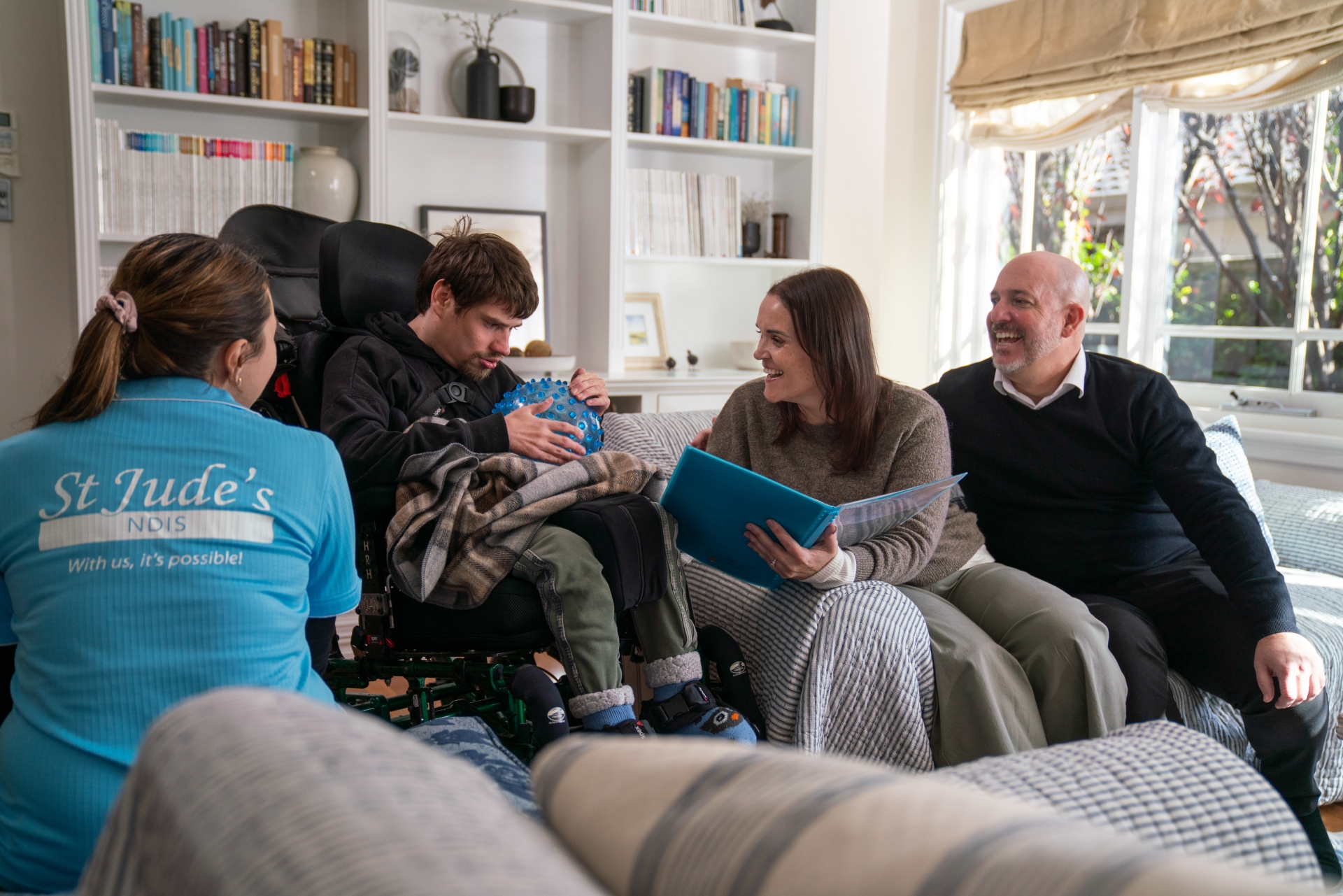
That’s where we come in. Here at St Jude’s, we’re an NDIS-registered disability and aged care provider that’s been supporting people across Western Australia and Queensland for over 40 years.
We offer Specialist Disability Accommodation in Perth and Brisbane, with housing and accommodation support to help you find the right fit. Our support coordinators can help you work through the Home and Living application, gather the right evidence, and connect you with the right people. Our allied health team, including occupational therapists, can complete the functional capacity assessment that forms the backbone of your SDA application.
St Jude’s doesn’t provide NDIS funding. That comes from the NDIA. What we provide is the services, coordination, and housing that help you use your funding well.
Whether you’re just starting to explore SDA or you’ve already been approved and want help finding the right home, we’re here when you’re ready. Get in touch or call us in WA on (08) 9279 4343, or in QLD on (07) 2800 6050.
You don’t need to have everything figured out before you reach out.
Frequently Asked Questions
The four SDA design categories are Improved Liveability, Fully Accessible, Robust, and High Physical Support. Each one is designed around a different type of disability need. Improved Liveability suits sensory, intellectual, or cognitive impairment. Fully Accessible is for significant physical impairment. Robust is for complex behaviours that may pose safety risks. High Physical Support combines full wheelchair accessibility with specialist equipment like ceiling hoists and emergency backup power.
In most cases, your plan will specify one design category. However, in rare and well-evidenced situations where you have both physical and behavioural support needs, the NDIA may approve a combination. A single dwelling can also be enrolled in more than one category. Your occupational therapist’s assessment should clearly describe the full range of your needs.
SDA funds the physical home. SIL (Supported Independent Living) funds the support workers who help you with daily tasks inside the home. They’re assessed separately and funded from different parts of your NDIS plan. You can have SDA without SIL, SIL without SDA, or both.
Your occupational therapist will recommend a design category as part of your functional capacity and housing assessment. The recommendation is based on how your disability affects your daily functioning and what kind of housing features you need to live safely. A support coordinator can help you find the right OT and start the process.
The NDIA aims to finalise Home and Living applications within 90 days. Gathering the evidence beforehand, including the OT assessment and medical reports, can take several months. The full journey from first conversation to moving into an SDA home can take anywhere from 6 to 18 months, depending on your circumstances and what’s available in your area.
